
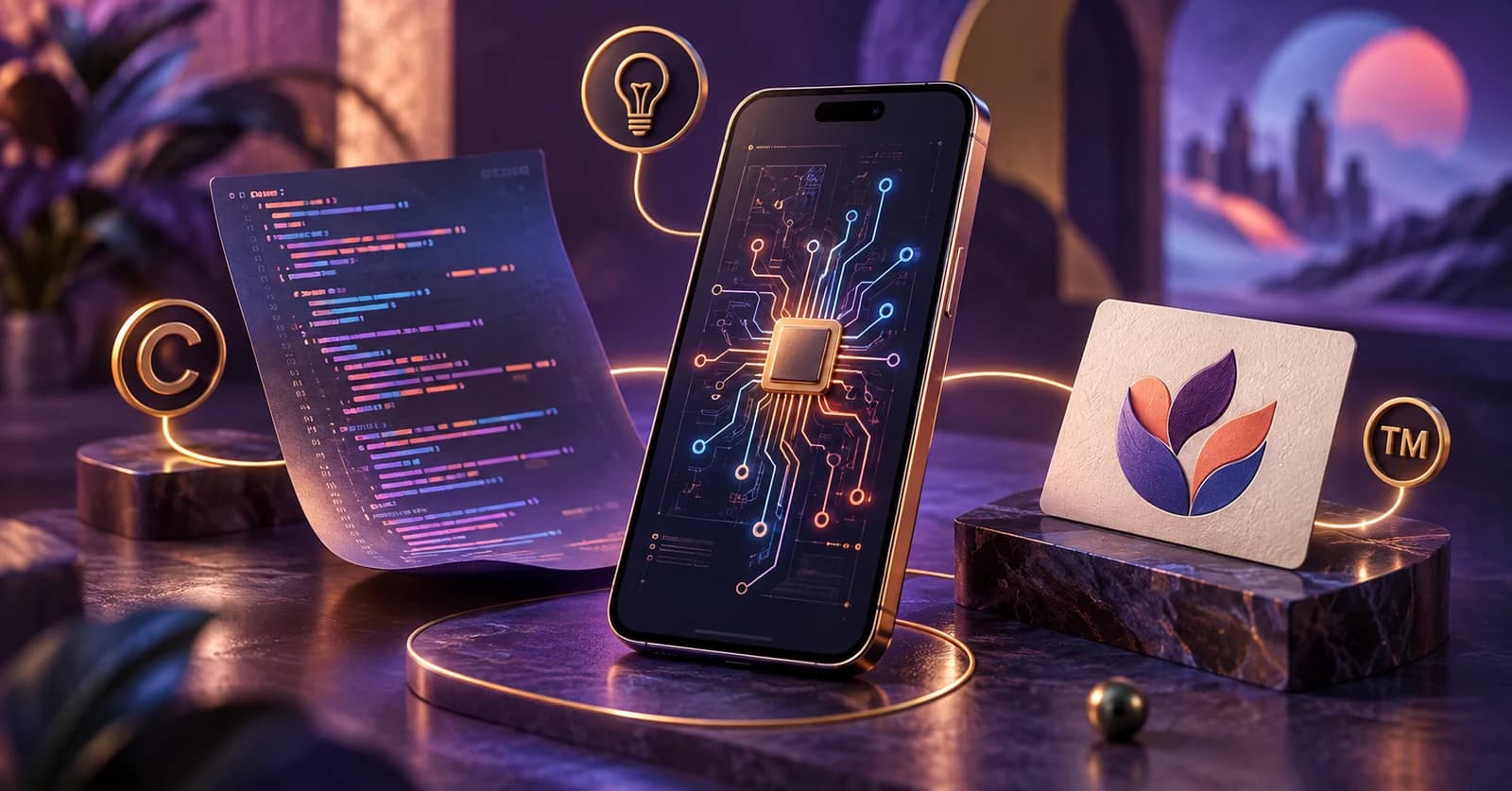
Mobile app patents, copyright, trademarks and trade secrets address different parts of a product. Choosing one does not resolve every ownership or copying concern. Start with the asset you want to protect and the commercial risk you want to manage. WIPO’s mobile app IP toolbox describes how multiple forms of intellectual property can coexist in an application.
Written by the Esperto Technologies engineering team. Sources checked 4 October 2026. This is general educational information, not a legal opinion on your invention. Ask a qualified patent professional in your intended filing countries to assess eligibility, disclosure and filing deadlines.
Which protection applies to each part of an app?
| App asset | Protection to discuss | Question for your adviser |
|---|---|---|
| A proposed technical invention | Patent | Is the claimed mechanism eligible, new and sufficiently inventive in the target jurisdiction? |
| Original source code, illustrations and text | Copyright | Who owns each contribution and what permissions cover third-party material? |
| App name and identifying logo | Trademark | Is the brand available for the relevant goods, services and markets? |
| Valuable confidential implementation knowledge | Trade secret | What information is actually secret and what measures maintain that secrecy? |
| Visual appearance of an interface | Potential design protection and/or copyright | Which jurisdiction-specific rights might cover the particular visual elements? |
This is a discussion map, not a finding that each asset qualifies. For the patent question specifically, start with our guide to a patent for mobile applications.
Copyright protects expression rather than the app idea
Copyright can cover original software code and creative assets. It generally protects their expression rather than the underlying idea, procedure or method of operation. Consequently, writing code for a booking app does not itself give you exclusive rights to the concept of mobile booking. See WIPO’s copyright overview.
For the development team, the practical task is an asset inventory. Record which modules were written for the project, which were licensed and which came from a customer's existing system. Keep the repository history and handover list. Treat fonts, illustrations, photographs and sample datasets as separate assets, rather than assuming they share the source code's permissions.
Trademarks address the brand customers recognise
A trademark distinguishes the goods or services of one enterprise from another. The app name or logo may therefore raise trademark questions separate from the code and functionality. Domain registration and an available app-store name are not substitutes for checking trademark rights. Consult WIPO’s trademark guidance and a professional for your target markets.
Keep a working-name field in design files until brand review is complete. That makes it easier to change splash screens, email templates, push notifications, store artwork and support content together. A late name change is less disruptive when branding is configured centrally and the release checklist lists every customer-facing asset.
Trade secrets depend on maintaining confidentiality
Trade-secret protection can concern commercially valuable secret information that is subject to reasonable measures to keep it secret. It does not offer the same protection against independent development or lawful reverse engineering as a patent right might. WIPO explains the conditions and limits of trade secrets.
Operationally, separate public product documentation from restricted implementation material. Decide who can access architecture notes, private repositories and experiment results. Review sharing links when a supplier leaves the project. An NDA is part of the arrangement; it does not replace access controls, careful disclosure or a clear record of recipients.
A mobile application patent is a separate assessment
A patent concerns a qualifying claimed invention. App developers should not describe a product as patentable simply because its interface looks different from competitors. India and the US apply different legal frameworks to software-related inventions, discussed in our main patent guide. The development brief should explain the mechanism and supporting evidence without pre-judging the legal conclusion.
Patentability also differs from freedom to operate. Having your own patent does not automatically mean that commercialising the product avoids others' rights. A separate review may consider third-party claims, countries and legal status. WIPO’s freedom-to-operate explanation sets out that distinction.
Example: an offline field-service application
Imagine an app that lets technicians record inspections without a reliable connection. Its brand name, original screen illustrations, code and confidential server configuration are different assets. A proposed synchronisation mechanism is another item to discuss with a patent professional. This fictional example is not a claim that offline synchronisation is new or patentable.
Create one asset register with a row for each item. The product manager identifies its use; the engineer identifies its repository or document; the designer identifies the source of visuals; and the legal adviser reviews ownership, permissions and possible protection. This helps the team avoid treating a general “IP ownership” clause as a complete inventory.
Ownership questions before hiring an app developer
- Which deliverables are created specifically for you, and which tools or components remain pre-existing?
- When and under what agreement are rights assigned or licensed?
- Who controls the source repository, app-store accounts, cloud accounts and signing credentials?
- Which open-source and commercial dependencies are used, and where are their licences recorded?
- Who contributed to a possible invention, and what dated records describe those contributions?
- What happens to access, copies and support obligations after handover?
These are questions to resolve in the project agreement. Payment for development and possession of a repository should not be used as substitutes for reviewing the actual rights and obligations.
A practical handover pack
Request a tagged release, setup instructions, dependency inventory, design-source files, deployment notes and an account-ownership register. For a project involving patent review, add the technical document version shared with the adviser and a change log of later implementation changes. Keep legal filings and engineering records clearly labelled so nobody mistakes a design document for an official submission.
Frequently asked questions
Can an app have more than one kind of protection?
Yes. Different rights can apply to different assets within the same product, subject to local law. The table above helps organise the questions; it is not a registration or enforcement assessment.
Can a patent stop every similar app?
No blanket conclusion follows from an app's appearance or category. A professional must consider the patent's claims and the relevant implementation and territory.
Can Esperto register these rights for me?
Our offer here is technical development and documentation support. Engage your own qualified IP professional for legal advice, searches, registrations, claim drafting and representation.
Turn the technical idea into a reviewable system
Esperto can help document architecture, develop a focused prototype and organise implementation evidence for your patent professional. Explore our mobile app patent technical support or mobile app development services. Start with a non-confidential summary; arrange the appropriate confidentiality terms before sharing unpublished technical details.