
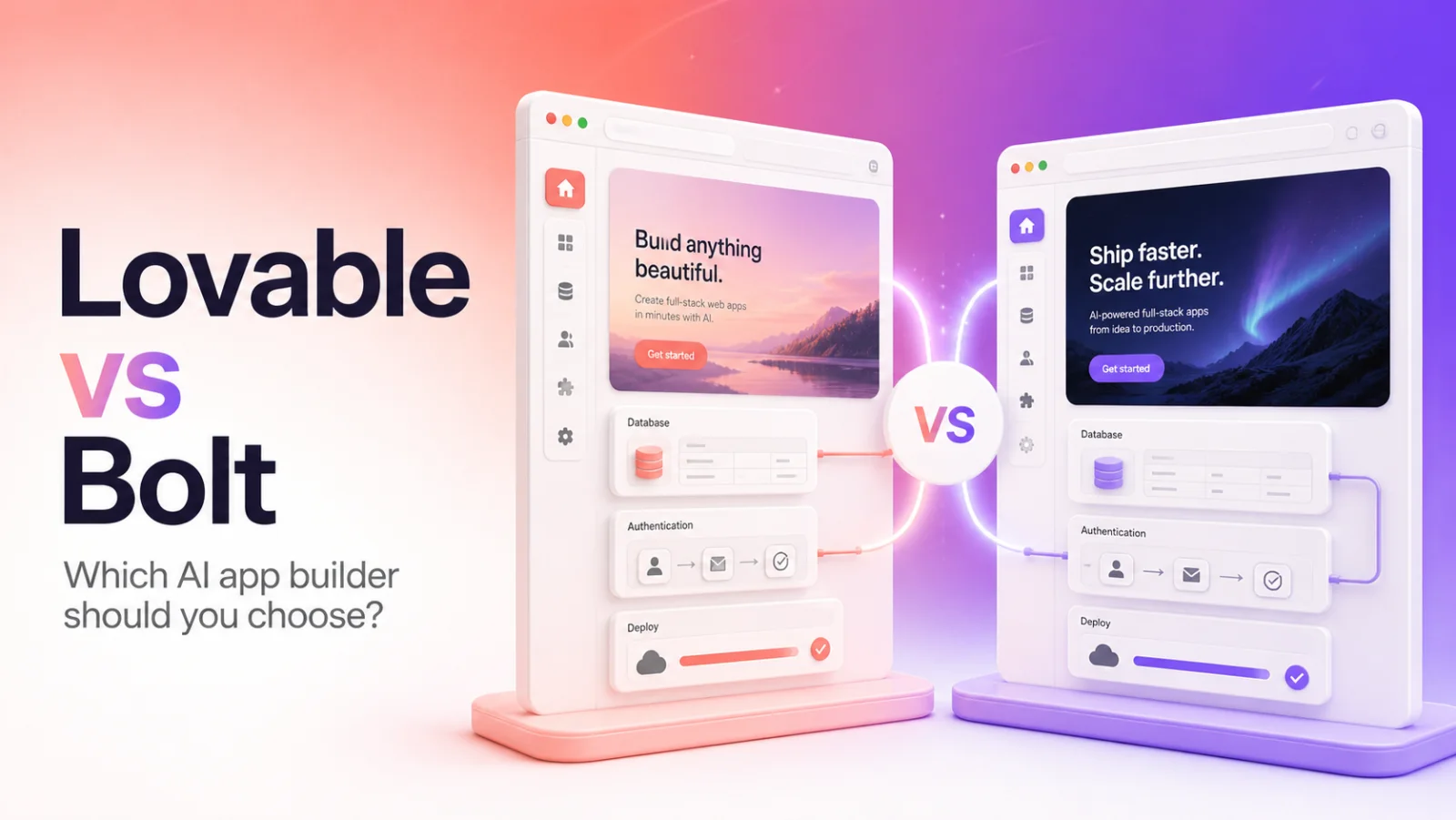
Lovable vs Bolt compares two browser-based AI development platforms that can turn a natural-language request into a working web application. Both can dramatically shorten the path from idea to prototype, but their workflow, infrastructure, pricing and ideal users are not identical.
Lovable vs Bolt at a glance
| Area | Lovable | Bolt |
|---|---|---|
| Primary experience | Conversational full-stack product builder | AI app builder with an in-browser development environment |
| Audience | Founders, product teams, designers and developers | Builders who want prompt-driven creation with visible project files and runtime |
| Backend | Lovable Cloud and integrations, including authentication and data services | Can build full-stack JavaScript applications and connect external services |
| Code ownership | Lovable states that customers own their code and can sync to GitHub | Projects can be exported or connected to GitHub, subject to current features |
| Billing | Credit-based building plus cloud and AI usage | Token-based allowances; project size can affect consumption |
Reviewed 7 August 2026. Check Lovable pricing and Bolt pricing before purchasing because credits, tokens and included services change.
What is Lovable?
Lovable describes itself as a full-stack AI development platform that builds web applications from natural language with editable code. Its documented workflow covers frontend, backend, database, authentication, integrations, GitHub sync, deployment and governance.
Lovable also provides design guidance that can present multiple visual directions before a build. This is useful when a user knows the product goal but has not decided on typography, palette or layout. Agent mode can modify files and use verification tools such as browser checks and tests.
What is Bolt?
Bolt is a browser-based AI website and app builder built around a live development environment. It can generate and modify project files, run the application and let a user inspect the result without installing a local toolchain. This makes it useful for rapid experimentation and for builders who want more visibility into the code workspace.
Bolt’s pricing page explains that much token use relates to synchronising the project filesystem with the AI. Larger projects may therefore consume more tokens per request, an important consideration for long-running products.
Design and first-build experience
Lovable’s design-direction workflow can help non-designers choose between visual approaches before committing. It is well suited to product briefs such as SaaS dashboards, marketplaces, client portals and marketing websites where coherent presentation matters.
Bolt can also create polished interfaces, but its browser IDE character is more visible. Users comfortable reviewing files, dependencies and runtime output may appreciate the directness. The result from either tool still depends heavily on the prompt, references and iteration.
Backend, authentication and data
Lovable Cloud provides hosted services such as database, authentication, file storage and server functions, while Lovable also supports integrations. Its built-in payments documentation covers Stripe and Paddle for eligible digital products on paid plans.
Bolt can connect applications to services such as Supabase and other deployment or data providers. The important difference is not whether a login screen can be generated; it is whether authentication rules, database permissions, webhooks, environment variables and failure cases are implemented securely.
Production checklist
- Review database access policies and role permissions.
- Keep API keys in secure environment variables.
- Test signup, login, password reset and account deletion.
- Validate payments with test and failure scenarios.
- Check server-side validation, not only browser validation.
- Configure backups, logs, monitoring and ownership.
GitHub and portability
Lovable documents a workflow in which teams build, review, sync to GitHub and deploy according to their standards. Bolt also supports moving code into a repository workflow. In both cases, connect GitHub early if the product may become important.
Code export is only one part of portability. Audit database schemas, hosted functions, storage, authentication, domains, secrets and deployment configuration. A repository may be portable while the running product still depends on platform services.
Pricing and usage
Lovable uses credits across building and, under its updated billing model, running cloud and AI features. The cost of a build request can vary by complexity. Bolt uses token allowances, and larger codebases can require more context on each turn.
Estimate total cost across four categories: AI building usage, production hosting, external services and professional review. A low subscription fee does not include payment processing, email, databases, observability or the work required to secure and maintain an application.
Who should choose Lovable?
- Founders who want a guided path from product brief to deployed web app.
- Teams that value design directions and integrated cloud services.
- Mixed technical and non-technical teams collaborating in one workspace.
- Builders who want GitHub sync but prefer to begin conversationally.
Who should choose Bolt?
- Builders who want an AI app generator inside a visible browser development environment.
- Developers exploring JavaScript projects and dependencies interactively.
- Users who want to inspect files and runtime output throughout generation.
- Rapid prototypes where a browser-native toolchain is convenient.
Final verdict
Lovable and Bolt can both create convincing applications quickly. Lovable feels closer to a guided product platform with integrated design, cloud and business workflows. Bolt feels closer to an AI-controlled development environment running in the browser. Choose with a real pilot and include deployment, data ownership, security and maintenance in the evaluation.
Also compare Bolt vs v0 if frontend design and the Vercel ecosystem are central to your decision.