
Most serious security failures are not caused by a complete absence of security tools. They happen because a team misunderstood how a system could be abused, overlooked a trust boundary, made an unsafe design assumption or protected the wrong thing.
Threat modeling is a structured way to examine a system from an adversarial perspective before those assumptions become incidents. It helps teams understand what they are building, what could go wrong, what they will do about it and whether the resulting defenses are sufficient.
What is threat modeling?
NIST defines threat modeling as a form of risk assessment that models attack and defense aspects of a logical entity such as data, an application, a host, a system or an environment. The OWASP Threat Modeling Cheat Sheet describes it as a structured, repeatable process for understanding a system's security characteristics, identifying applicable threats and determining responses.
Threat modeling is broader than listing vulnerabilities. A vulnerability is a weakness. A threat describes how an actor or event might exploit conditions to harm an asset. Risk adds business context: likelihood, impact, exposure and the effectiveness of existing controls.
The output is not only a diagram. A useful threat model produces shared understanding, documented assumptions, prioritized threats, security requirements, owners and tests.
Why threat modeling matters
- It finds design problems early. Changing an authorization model on a diagram is easier than rebuilding it after launch.
- It focuses security work. Teams can spend effort on credible attack paths instead of applying every control everywhere.
- It exposes hidden assumptions. Diagrams often reveal implicit trust between services, users, vendors and networks.
- It improves communication. Product, engineering, operations and security can discuss the same system model.
- It creates testable requirements. Identified threats can become acceptance criteria, automated tests and monitoring signals.
Threat modeling does not predict every attack. Its value is systematic thinking: reducing unknowns and making important decisions visible before they become expensive.
The four questions that demystify the process
The OWASP Threat Modeling Project recommends a methodology-neutral four-question framework:
1. What are we working on?
Define the scope and model the system. Identify users, administrators, services, APIs, data stores, third parties, deployment environments and important assets. Record assumptions and show where data moves.
2. What can go wrong?
Explore how an attacker, malicious insider, compromised dependency, misconfiguration or simple failure could violate security objectives. Consider identity, data, business logic, availability, privacy and operational control.
3. What are we going to do about it?
Choose a response for each meaningful threat: mitigate it, eliminate the risky feature or design, transfer a defined responsibility, or explicitly accept the remaining risk. Convert mitigations into owned engineering work.
4. Did we do a good enough job?
Review whether the model is accurate, the important threats were considered, decisions are justified and mitigations can be verified. “Good enough” depends on business impact and risk tolerance—not the number of threats in a spreadsheet.
Step 1: define scope and security objectives
Start with a manageable subject: a new payment flow, authentication service, file upload, partner API or major architectural change. Trying to model an entire enterprise in one session produces a map too broad to support decisions.
Write down what must remain true. Examples include:
- Only an account owner can view or change their financial data.
- Support staff cannot approve their own privileged access.
- A tenant cannot read another tenant's records.
- Critical transactions remain traceable and resistant to alteration.
- The service can recover within its agreed operational objective.
Security objectives anchor the discussion in outcomes. Without them, workshops drift into generic lists of attacks.
Step 2: model the system and its data flows
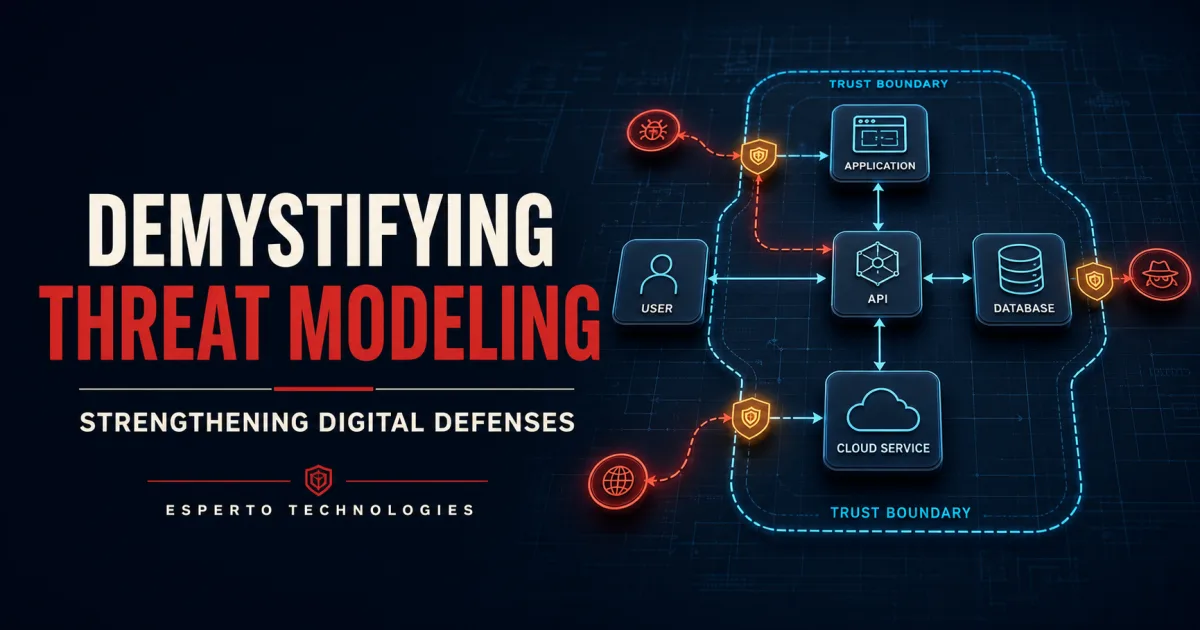
A data-flow diagram is a common starting point because it shows external entities, processes, data stores, data flows and trust boundaries. It does not need to reproduce every class or network route. It needs enough detail to reason about security.
For each flow, ask:
- What data crosses this path, and how sensitive is it?
- How are both ends authenticated and authorized?
- Where does trust increase or decrease?
- Is the data validated, encrypted, logged or retained?
- What happens if the destination is unavailable or malicious?
Trust boundaries deserve special attention. A browser calling an API, a workload assuming a cloud role, a service querying a database and a platform sending data to a vendor all cross boundaries—even when they run inside one company's cloud account.
Step 3: identify threats using STRIDE
STRIDE is a practical prompt developed at Microsoft. It does not replace creative thinking, but it helps teams avoid obvious gaps.
| Category | Security property | Questions to ask |
|---|---|---|
| Spoofing | Authentication | Can someone impersonate a user, service or device? |
| Tampering | Integrity | Can data, code, configuration or messages be changed? |
| Repudiation | Accountability | Can an action be denied because evidence is missing or untrusted? |
| Information disclosure | Confidentiality | Can sensitive information reach an unauthorized party? |
| Denial of service | Availability | Can a resource be exhausted, blocked or made unaffordable? |
| Elevation of privilege | Authorization | Can someone gain capabilities beyond their intended role? |
Apply the prompts to elements and flows in the actual diagram. “The API may be attacked” is too vague. “An authenticated tenant changes the account identifier in the invoice endpoint to read another tenant's invoice” is actionable: it identifies the actor, entry point, action and impact.
Beyond STRIDE: choosing a method
There is no universal methodology. STRIDE is approachable for product and architecture work. PASTA uses a risk-centric, attack-oriented process. LINDDUN focuses on privacy threats. Attack trees decompose an attacker goal into possible routes. Abuse cases describe malicious or unintended interactions with a feature.
Choose the lightest technique that produces good decisions for the system. A method should support thinking, not become a compliance ritual. Teams can combine techniques when a system has specialized safety, privacy or regulatory needs.
Step 4: prioritize threats responsibly
Not every hypothetical deserves equal effort. Prioritize using evidence available to the team:
- Business and user impact
- Exposure and reachable attack surface
- Required attacker access and capability
- Existing preventive and detective controls
- Ease of exploitation and opportunities for automation
- Blast radius, reversibility and recovery difficulty
Numeric risk scores can help sort work, but false precision is dangerous. Document uncertainty and assumptions. When impact is catastrophic or irreversible, low confidence about likelihood should not automatically push the risk to the bottom.
Step 5: choose and track responses
Each prioritized threat needs a decision:
- Mitigate: reduce likelihood or impact with a control.
- Eliminate: remove the dangerous feature, flow or trust relationship.
- Transfer: assign a clearly defined responsibility through architecture, service or contract.
- Accept: document why the residual risk fits the organization's tolerance.
A mitigation should be specific and testable. Replace “use strong authentication” with “administrative accounts require phishing-resistant multifactor authentication, short sessions and reauthentication for privilege changes.” Add an owner, target release and verification method.
Step 6: validate the model and controls
Review the model with people who understand architecture, product behavior, operations and business impact. Confirm that the diagram matches reality and that important dependencies, administrators and failure paths are present.
Then verify mitigations through design review, code review, unit and integration tests, security testing, configuration checks or operational exercises. Microsoft describes threat modeling as a core part of its Security Development Lifecycle, including defining requirements, diagramming, identifying threats, mitigating and validating the mitigations.
A worked example: document upload
Consider a business application where customers upload identity and financial documents. The flow includes a browser, upload API, object storage, malware scanner, extraction service, database and staff review portal.
Potential threats include:
- A user uploads active content that executes in a staff browser.
- An object identifier exposes another customer's file.
- A forged callback marks an unscanned file as safe.
- Oversized or compressed files exhaust processing resources.
- Sensitive files remain in temporary storage beyond their retention period.
- A support user downloads documents without a valid business purpose.
Responses may include allow-listed formats, content validation, isolated processing, authorization on every object request, signed service messages, quotas, retention policies, download auditing and alerting for unusual staff access. The model turns “secure file uploads” into explicit requirements and tests.
Threat modeling for cloud, APIs and AI
Cloud systems
Include identity roles, managed services, control planes, network boundaries, infrastructure-as-code, tenancy and shared responsibility. A vendor-managed service removes some operational tasks, not the need to understand access and data exposure.
APIs and microservices
Model service identities, object-level authorization, asynchronous messages, retries, schema validation and the blast radius of compromised credentials. Internal network location is not proof of trust.
AI-enabled applications
Add model providers, prompts, retrieved data, tools, generated output and human review. Consider prompt injection, excessive agency, sensitive-data leakage, unsafe output handling, model or dataset supply chains and the consequences of probabilistic behavior.
How threat modeling fits DevSecOps
Threat modeling supplies context that automated security tools lack. The model identifies which trust boundaries, assets and abuse cases matter; the pipeline helps enforce and test resulting controls.
Trigger a review when a team introduces a sensitive data type, new external integration, authentication or authorization change, public endpoint, privileged workflow, infrastructure boundary or major architecture change. Store the model near engineering documentation, link threats to the work tracker and update it with the system.
For a broader view of integrating security throughout delivery, read Demystifying DevSecOps: Integrating Security into the Heart of Development.
Common threat modeling mistakes
- Modeling too much at once. Narrow the scope to a decision or high-risk flow.
- Inviting only security specialists. The people who built and operate the system hold essential context.
- Starting from a generic threat list. Build an accurate system model first.
- Ignoring business logic. Many damaging abuses use valid features in unintended sequences.
- Producing a document without owners. Every important response needs accountable follow-through.
- Treating the model as final. Architecture, attackers and dependencies change.
A lightweight 60-minute workshop
- 0–10 minutes: agree on scope, assets and security objectives.
- 10–25 minutes: draw components, flows, identities, stores and trust boundaries.
- 25–45 minutes: use STRIDE, abuse cases and team experience to identify threats.
- 45–55 minutes: prioritize the most meaningful risks and choose responses.
- 55–60 minutes: assign owners, validation methods and the next review trigger.
A short model for every meaningful design change is often more valuable than a perfect document created once a year.
Frequently asked questions
Is threat modeling the same as penetration testing?
No. Threat modeling reasons about design and potential abuse, often before implementation. Penetration testing evaluates a running system. They provide complementary evidence.
Do we need special software?
No. A whiteboard or diagram tool and an issue tracker can be enough. Dedicated tools help standardize diagrams, prompts and tracking when scale demands them.
When should threat modeling happen?
Begin during design and update the model when architecture, data, exposure, identity, dependencies or important business flows change.
Who should participate?
Include people who understand product behavior, architecture, development, operations and security. Add privacy, fraud, compliance or business specialists when the system requires their context.
How detailed should a threat model be?
Detailed enough to support decisions and tests. Use a high-level model for system context and focused diagrams for high-risk flows rather than placing everything on one page.