
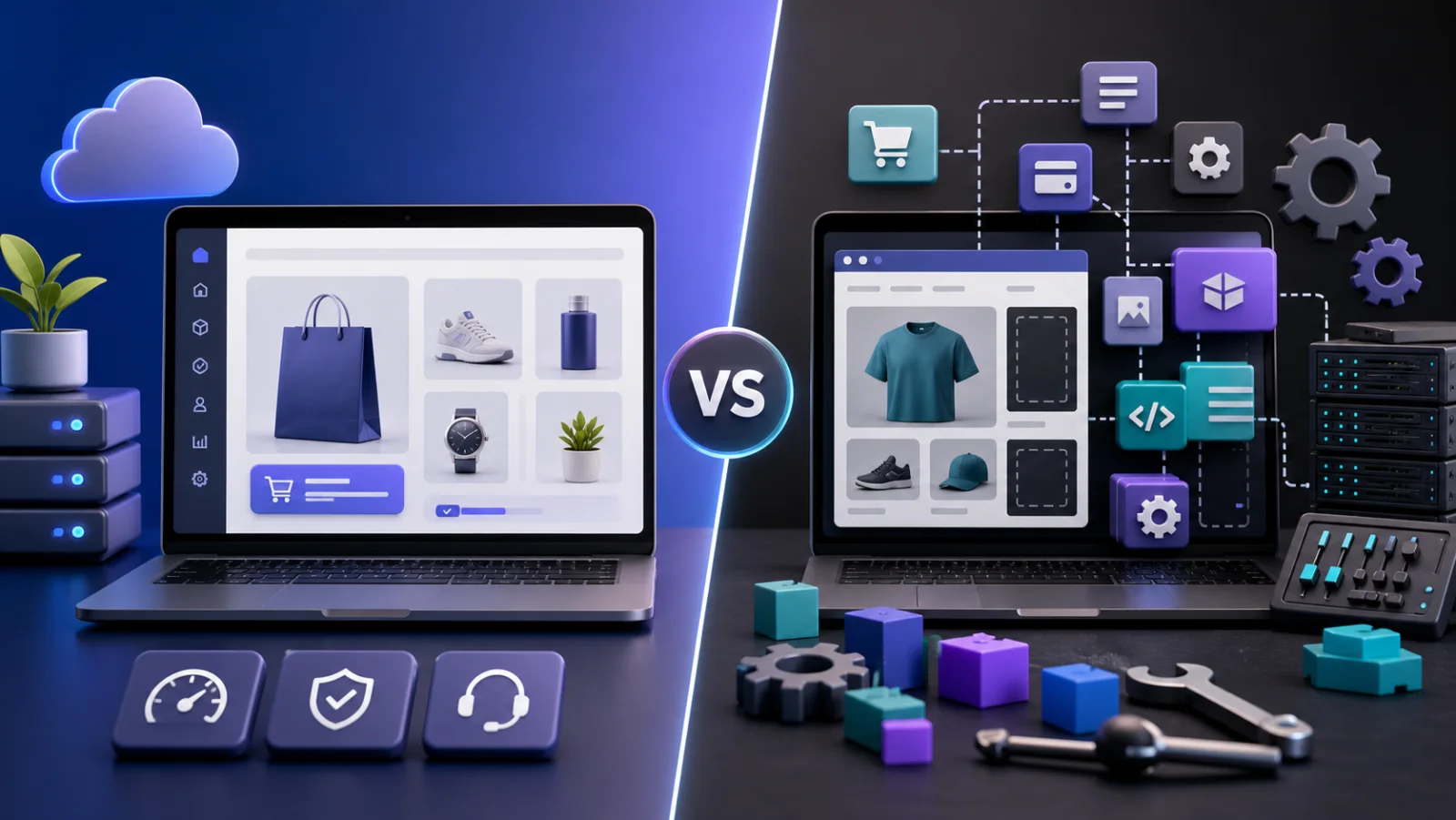
Shopify vs WooCommerce is a decision about operating model as much as features. Shopify bundles managed hosting and core commerce into a subscription platform. WooCommerce adds open-source commerce to WordPress while leaving the merchant or developer to choose and maintain the surrounding infrastructure.
Affiliate disclosure: Esperto does not use affiliate tracking links in this article at publication. Future affiliate relationships will be disclosed, and qualifying links will be marked as sponsored.
Our comparison method
Reviewed 10 August 2026 using official platform, pricing and help documentation. The reference requirement is a 25-product physical-goods store with variants, online payment, COD, shipping, discounts, analytics and a custom domain. We evaluated responsibilities and likely cost categories; we did not conduct a controlled speed, conversion or support test.
Shopify vs WooCommerce at a glance
| Area | Shopify | WooCommerce |
|---|---|---|
| Model | Hosted commerce SaaS | Open-source WordPress plugin |
| Hosting | Included | Chosen and paid separately |
| Core updates | Managed by platform | Site owner manages WordPress, plugin and extension updates |
| Customisation | Themes, apps and platform APIs | Themes, plugins and direct code or infrastructure access |
| Best fit | Owners wanting a concentrated managed system | Teams wanting WordPress and stack control |
| Main risk | Recurring ecosystem costs and platform constraints | Maintenance, compatibility, security and variable infrastructure costs |
Setup and hosting
Shopify includes secure commerce hosting, bandwidth and SSL in its paid store plans. The merchant creates an account, selects a theme, configures products and connects a domain without selecting a separate web host.
WooCommerce requires a WordPress site and hosting. That gives the merchant a choice of infrastructure and provider, but someone must manage backups, caching, security, email delivery, updates and incidents. Managed WooCommerce hosting can reduce this burden without making it disappear.
Ownership and control
WooCommerce provides broader code and infrastructure access because the store runs in the merchant’s WordPress environment. That can be valuable for specialised content models, integrations or development workflows. It also means a bad plugin or careless update can affect the store.
Shopify provides data and theme customisation within its platform model while controlling more of the runtime and checkout environment. This reduces routine infrastructure choices but creates platform-specific constraints and migration work.
Cost: subscription versus assembled stack
Shopify India currently lists Basic from ₹1,499 per month billed yearly or ₹1,994 monthly. Optional themes, apps and third-party payment terms can add cost. Check current Shopify India pricing.
WooCommerce core is free to download, but WooCommerce’s own cost guidance identifies hosting and optional extensions as separate investments; official extensions can carry annual subscriptions. Add domain, theme, backups, security, development and maintenance. Review the official WooCommerce pricing guide.
A fair comparison uses total cost over two years and includes the labour required to keep the store reliable.
Payments and checkout
Both ecosystems integrate with payment providers, subject to country and merchant availability. Shopify may charge a plan-dependent third-party transaction fee in addition to the external provider’s fees. WooCommerce itself does not impose the same hosted-platform transaction layer, but the selected gateway, extensions and implementation have their own terms.
For India, verify UPI, cards, net banking, COD, refunds, webhooks, settlement and GST documentation directly with the chosen gateway. Never assume a provider listed globally is available for every merchant.
Extensions and custom development
Shopify uses an app ecosystem and platform APIs. Apps are easy to discover and install, but several recurring subscriptions can materially change total cost. Confirm whether an app stores critical data and how the store behaves if it is removed.
WooCommerce uses WordPress plugins and extensions. The choice is broad, but compatibility and update quality vary. Prefer maintained extensions, minimise overlapping plugins and test updates away from production.
SEO and content
Shopify provides the core controls needed for product, collection and content discovery while maintaining a predictable hosted foundation. WooCommerce inherits WordPress’s flexible publishing and plugin ecosystem, which can provide deeper control but also more ways to create duplicate, slow or poorly configured pages.
Neither platform guarantees rankings. Useful category content, original product information, crawlable architecture, internal links, performance and authority matter more than the platform label.
Security and maintenance
Shopify manages the hosted platform and states that stores are PCI compliant by default. Merchants still remain responsible for account security, permissions, apps, content and lawful operation.
With WooCommerce, the merchant and providers share more responsibility. Use supported software, limited administrator access, strong authentication, backups, monitoring and a tested update process. Open-source access is valuable only when paired with maintenance discipline.
Choose Shopify if
- you want hosting and core platform operations managed together;
- your team wants to focus on products, marketing and fulfilment;
- the app ecosystem covers expected requirements; or
- predictable platform administration is more important than server control.
Choose WooCommerce if
- WordPress is central to your content strategy;
- you need direct implementation or infrastructure control;
- your team can maintain hosting, plugins, security and backups; or
- the required workflow does not fit comfortably inside a hosted platform.
Final verdict
Shopify is the safer default for a small business that wants to minimise technical ownership. WooCommerce is the stronger fit when control is a real requirement and the business has the capability to maintain what it controls. “Free plugin” and “monthly plan” are not sufficient cost comparisons; model the complete stack and responsible labour.
Frequently asked questions
Is WooCommerce cheaper than Shopify?
Sometimes, but not automatically. Hosting, paid extensions, implementation and maintenance can make WooCommerce more or less expensive depending on the store.
Which is easier to maintain?
Shopify usually requires less infrastructure maintenance because hosting and platform updates are managed. WooCommerce provides more control and therefore more responsibility.
Can WooCommerce handle a large store?
It can, with suitable architecture, hosting, database work and operations. Scale depends on implementation rather than the plugin name alone.
Can I migrate between them?
Yes, but products and orders are only part of the work. Themes, apps, customer access, SEO URLs, integrations and historical data need a migration plan.
Compare the broader market in the best ecommerce website builder guide, read Shopify vs Wix, or discuss a done-for-you ecommerce implementation.