
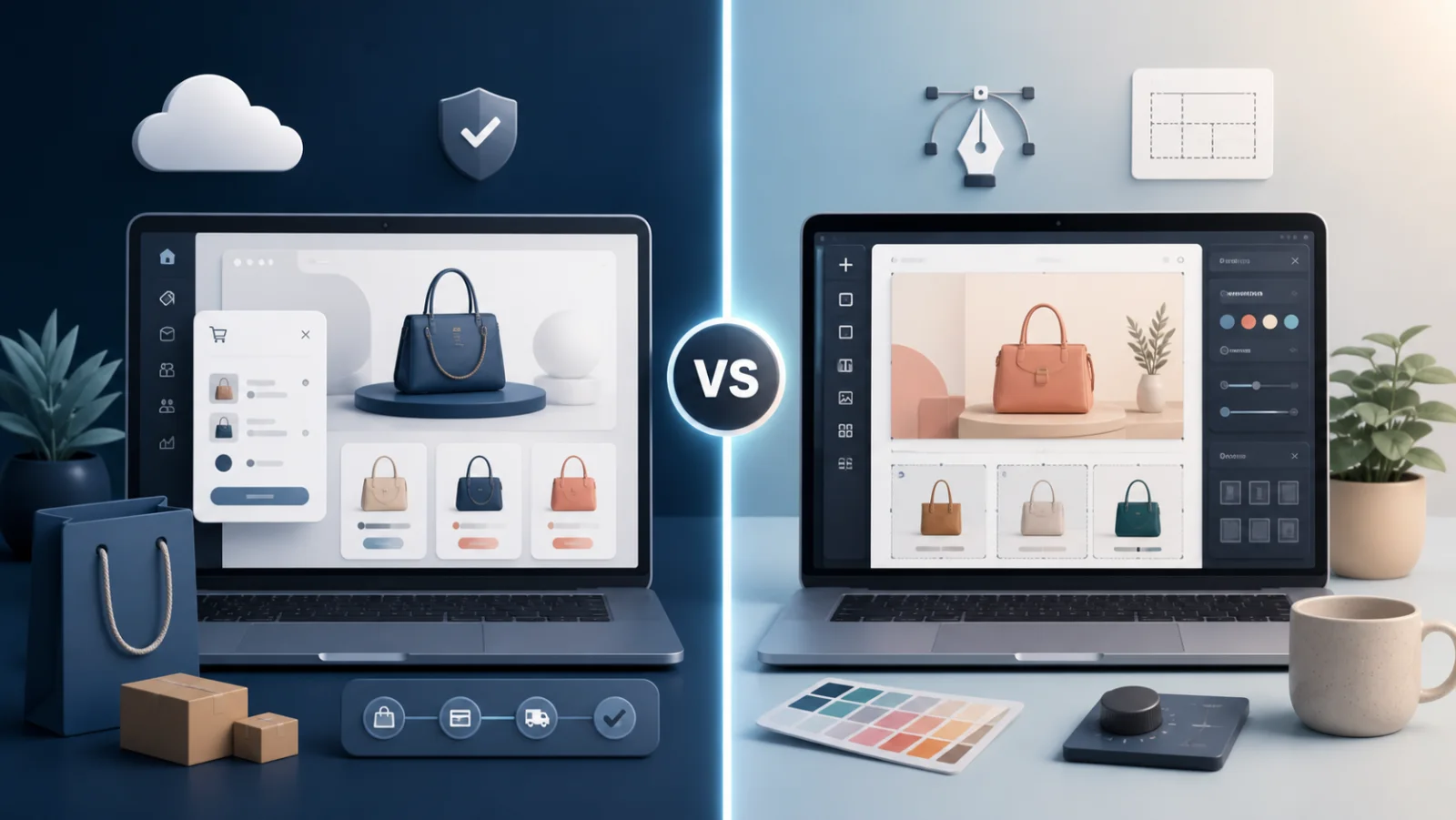
Shopify vs Wix is primarily a choice between a commerce-first platform and a visual website builder with integrated commerce. Shopify is the stronger default when the store is the business’s main operating system. Wix is compelling when flexible page creation and a mixed content-and-commerce website are the priority.
Affiliate disclosure: Links in this article currently lead to official documentation without affiliate tracking. If that changes, Esperto will label qualifying links, mark them as sponsored and update this disclosure.
Our comparison method
Reviewed 10 August 2026. We compared current official plan and help documentation against a reference store with 25 physical products, variants, online payment, COD, shipping, discounts, analytics and a custom domain. This is an editorial product assessment, not a controlled conversion, performance or customer-support test. Prices and features can change.
Shopify vs Wix at a glance
| Area | Shopify | Wix |
|---|---|---|
| Product focus | Commerce-first platform | Visual website platform with commerce |
| Hosting | Included | Included |
| Best fit | Store-led businesses | Small sites combining content, services and products |
| Design approach | Theme and section editing centred on commerce | Highly visual site editing |
| Operational depth | Strong commerce admin and app ecosystem | Good core tools for straightforward stores |
| Main cost risk | Apps, themes and transaction terms | Plan upgrades, apps and later workflow limits |
Store setup and ease of use
Both platforms include hosting and remove the need to maintain a separate server. Shopify’s onboarding, admin and theme system are organised around products, orders, customers and sales channels. Wix begins from a broader website-building experience, which can be intuitive when the store is one part of the site.
“Easy” changes after launch. Test how quickly staff can add a variant, refund an order, change inventory, create a coupon and export data. The best editor is not automatically the best daily operations system.
Design and content
Wix is the stronger starting point for free-form visual page composition. Shopify themes are more deliberately constrained around reusable commerce sections, which can protect consistency while limiting some page ideas unless a theme, app or developer extends them.
For either platform, select a theme based on catalogue navigation, product media, variants, mobile checkout and accessibility—not only its demo photography.
Products, inventory and orders
Shopify’s identity is commerce operations: products, inventory, orders, checkout, analytics and multichannel expansion live in one platform family. Wix supports the essential product and order workflows required by many smaller stores, including physical products, variants and CSV product management.
A merchant expecting multiple locations, complex promotions or extensive integrations should prototype those requirements before choosing Wix. A merchant with a small catalogue should still check whether Shopify’s broader commerce machinery justifies its total cost.
Payments and India-specific checks
Payment availability varies by country and merchant eligibility. Shopify’s India plans warn that third-party transaction fees may apply when an external payment provider is used; the stated rate depends on plan. Wix also requires merchants to check which payment providers are available for their business location and plan.
Do not choose based on a global feature page. Confirm UPI, cards, net banking, COD, settlement, refunds and every platform or gateway fee against current India-specific terms.
Pricing and true cost
Shopify India currently lists Basic at ₹1,499 per month billed yearly or ₹1,994 monthly, excluding optional themes, apps and relevant payment costs. Wix pricing and promotions can vary by location and billing term, so inspect the checkout for the exact commerce-capable plan. See the official Shopify pricing and Wix plans.
Calculate 24 months:
- base subscription;
- domain and email;
- premium theme or template;
- required apps;
- gateway and platform transaction charges;
- setup or development;
- ongoing content and support; and
- future migration work.
Data export and migration
Wix documents CSV product export for physical products, with current row limits and separate restrictions for digital-product export. Shopify also provides product and operational export workflows. An export is not a complete migration: layouts, URLs, app behaviour, customer passwords and some historical details may not transfer cleanly.
Choose Shopify if
- the website exists primarily to sell;
- commerce operations and integrations are the priority;
- the catalogue or team is expected to grow; or
- managed infrastructure is worth the ongoing subscription.
Choose Wix if
- the store is one part of a broader small-business website;
- visual page editing is especially important;
- the catalogue and fulfilment process are straightforward; or
- the owner wants a hosted site editor without WordPress maintenance.
Final verdict
Shopify wins for commerce-first operations and expansion. Wix wins for visual site creation around a simpler store. The deciding test is not which homepage looks better: it is which system completes your five most common order and catalogue tasks with fewer workarounds at an acceptable two-year cost.
Frequently asked questions
Is Wix cheaper than Shopify?
It can be for some requirements, but compare the exact commerce plan, billing term, apps, payment costs and implementation. Headline prices alone are not comparable.
Is Shopify better for SEO?
Both provide core SEO controls. Search performance depends more broadly on site architecture, content, crawlability, performance, authority and implementation quality.
Can I move from Wix to Shopify?
Yes, but expect to map products and data, recreate design and integrations, redirect URLs and test checkout. Confirm what can be exported before beginning.
Compare all three options in the small-business ecommerce builder guide, continue with Shopify vs WooCommerce, or discuss a done-for-you ecommerce implementation.