
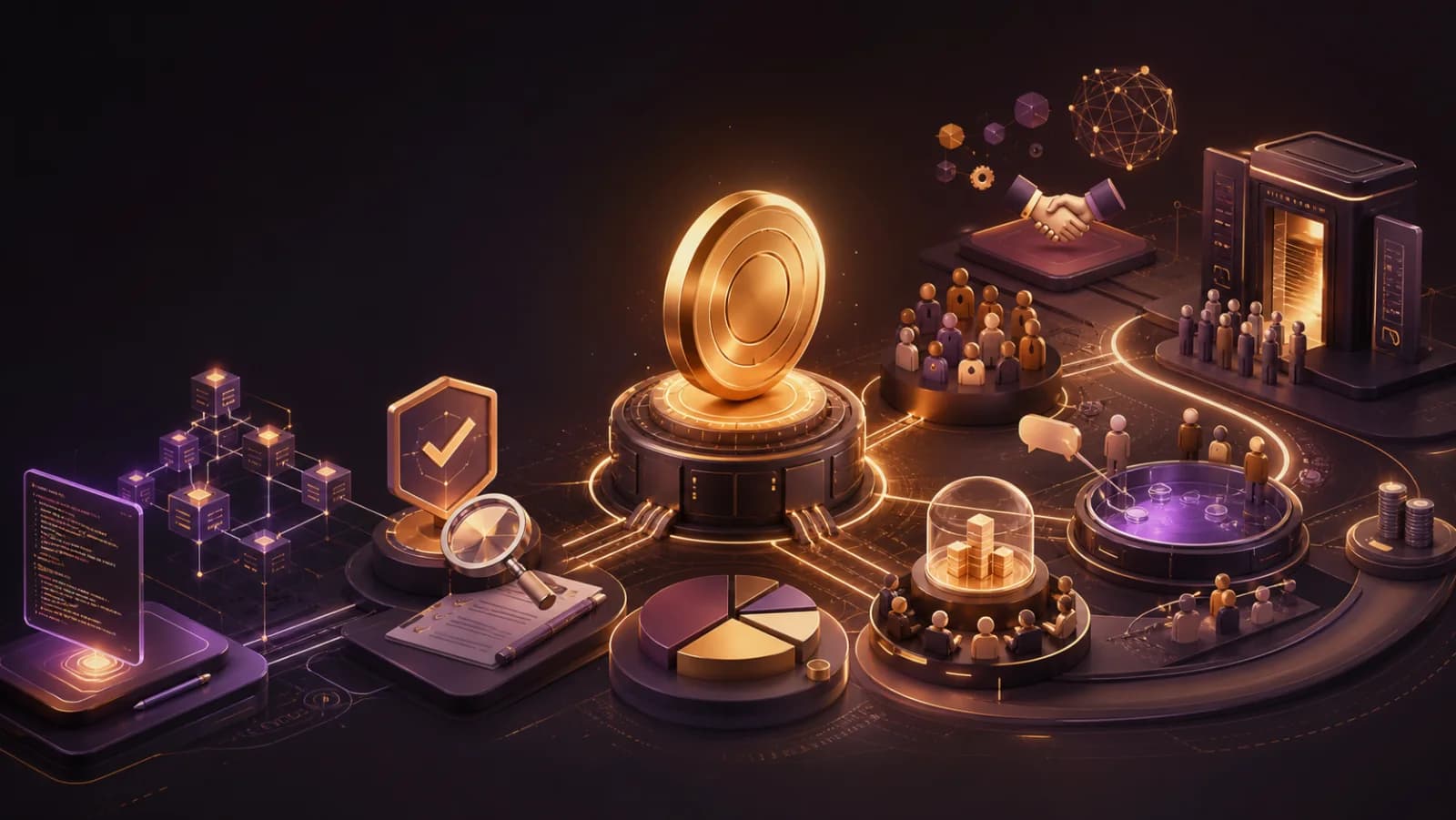
Creating a crypto token can take minutes. Creating a legitimate token project that people can understand, use, trade safely and trust can take months—and sometimes years. The smart contract is only one component. A credible launch also needs a reason to exist, legal analysis, token economics, security, treasury controls, product delivery, liquidity planning, documentation, community operations and transparent marketing.
This guide follows the complete journey from an empty document to a live token and the operating work after launch. It is written for founders and product teams evaluating a genuine blockchain product, not for anonymous “pump” campaigns or guaranteed-return schemes.
Quick answer: what do you need to launch a crypto token?
- A real problem and a clear reason a blockchain token is necessary.
- A legal entity, jurisdiction strategy and written regulatory analysis.
- A token model, supply policy, allocation and long-term incentive design.
- A blockchain and token standard appropriate for the users and product.
- Audited smart contracts, secure deployment and controlled administration.
- A working product or credible path to utility—not only a token website.
- Transparent documentation, risk disclosures and verifiable team information.
- Treasury, vesting, custody and accounting operations.
- A community and marketing programme that avoids misleading financial claims.
- A liquidity strategy and, only when ready, applications to appropriate exchanges.
Token, coin and protocol: understand the difference
A coin is generally the native asset of its own blockchain: it pays network fees and participates in the network’s economic security. Building one usually means creating or adapting a blockchain, validators, networking, wallets, explorers and an ecosystem.
A token is issued on an existing blockchain using a standard or programme. An ERC-20 asset on an EVM network and a token created through Solana’s token programmes are common examples. The existing chain provides consensus and transaction settlement, so token creation is substantially smaller than blockchain creation.
A protocol is the set of smart contracts and rules that delivers a service—such as lending, exchange, staking or governance. Its token may coordinate the protocol, but the token itself is not the product.
How many types of crypto tokens can you create?
There is no universally fixed count because tokens can combine several functions. These are the main design families:
| Token type | Primary purpose | Important design concern |
|---|---|---|
| Utility token | Access, credits, fees or functions inside a product | Utility must be real and usable, not a label placed over fundraising |
| Governance token | Voting or delegation over defined protocol decisions | Concentration, quorum, delegation and emergency powers |
| Payment token | Transfer value inside a network or marketplace | Liquidity, volatility, AML and payment regulation |
| Asset-referenced or stable token | Track a currency, commodity or basket | Reserves, redemption, attestations, custody and specialised regulation |
| Security or investment token | Represent financial rights, revenue, debt or ownership | Securities law, investor eligibility, disclosures and transfer controls |
| Real-world-asset token | Represent claims involving property, invoices or other off-chain assets | Legal enforceability and the trusted link between chain and real world |
| Wrapped or bridged token | Represent an asset from another chain or custody domain | Bridge, custodian and reserve risk |
| Liquidity or receipt token | Represent a pool, vault, deposit or staked position | Underlying contract, withdrawal and valuation risk |
| NFT | Represent a unique item, membership, credential or media right | Metadata persistence, intellectual property and transfer rules |
| Semi-fungible token | Represent classes, editions, tickets or game items | Batch operations and class-specific supply |
| Non-transferable credential | Reputation, qualification or account-bound rights | Privacy, revocation and recovery |
| Community or meme token | Coordinate identity and participation | Extreme speculation, weak utility and misleading promotion risk |
Step 1: begin with the problem, not the token
Write a one-page token necessity memo before tokenomics. It should answer:
- Who is the user, and what job are they trying to complete?
- What product exists without the token?
- Which action genuinely requires an open blockchain?
- Why would ordinary database credits, points or shares not work?
- Who creates value, who consumes it and who pays?
- What prevents the token from becoming a speculative layer disconnected from the product?
If removing the token makes the product simpler without reducing user value, do not launch a token yet. Build the product and demand first.
Step 2: establish the company, jurisdictions and legal classification
Legal work must start before a public sale, airdrop, exchange conversation or influencer campaign. Counsel should analyse the token’s rights, distribution, fundraising, governance, redemption, target users and marketing in every relevant jurisdiction.
Regimes differ. The EU’s Markets in Crypto-Assets Regulation includes white-paper and marketing requirements for covered public offers and admission to trading. Current US treatment depends on the asset and transaction; tokenized securities remain subject to securities law. FATF standards place AML/CFT expectations on covered virtual-asset service providers. In India, covered VDA service providers should review FIU-IND registration and AML guidance, while tax obligations for virtual digital assets require specialist advice.
Your legal workstream may need:
- entity formation and beneficial-ownership records;
- token classification memorandum;
- terms of use, privacy policy and risk disclosures;
- sale, distribution and geographic restrictions;
- KYC, sanctions screening and transaction-monitoring design;
- consumer, advertising, securities, commodities and payments analysis;
- tax treatment for the company, treasury and recipients; and
- intellectual-property and contributor agreements.
Step 3: choose the blockchain
| Decision | Questions to ask |
|---|---|
| Users | Where do intended users already hold wallets and assets? |
| Security | How mature are the chain, validators, clients and operational tooling? |
| Fees and throughput | Can target users afford normal and congested transactions? |
| Developer ecosystem | Are libraries, auditors, RPC providers, explorers and engineers available? |
| Liquidity | Which reputable DEXs, stable assets and market participants operate there? |
| Wallet support | Can users safely store and interact with the token? |
| Interoperability | Is multichain access truly required, and who assumes bridge risk? |
| Longevity | Is the network likely to support the product for years? |
EVM-compatible networks commonly use Solidity and ERC standards. Ethereum’s ERC-20 defines the familiar fungible-token interface; mature libraries such as OpenZeppelin provide reusable implementations. Solana provides its original Token Program and Token-2022 extensions. A standard token can be created without a custom on-chain programme, while unusual business logic may require one.
Step 4: define the token logic
Supply
- Fixed supply: all supply is created under a documented policy and no further minting is possible.
- Capped supply: minting may continue until a hard maximum.
- Elastic or emission supply: supply changes under explicit schedules or protocol rules.
- Burning: tokens can be destroyed, but burning does not automatically create sustainable value.
Permissions and control
List every privileged action: mint, pause, blacklist, upgrade, change fees, move treasury assets, modify metadata or recover funds. Assign each to a role, multisignature wallet or time-delayed governance process. OpenZeppelin’s role-based access-control patterns can separate responsibilities, but safe administration still depends on key management and operational procedures.
Transfer logic
Plain standards are generally easier for wallets, exchanges and auditors to support. Transfer taxes, rebasing, automatic liquidity, reflection rewards, deny lists and unusual hooks increase integration and security risk. Add them only when the product and legal model require them—not because another token used them.
Upgrades
Immutable contracts reduce administrative change but preserve bugs forever. Upgradeable contracts enable fixes and evolution but introduce privileged control and storage-layout risk. Document the upgrade authority, delay, review process and exit path. Never present an upgradeable token as immutable.
Step 5: design tokenomics as an operating system
Tokenomics is the relationship between supply, distribution, utility, incentives and demand. A pie chart is not a model. Build a spreadsheet or simulation that covers circulating supply, unlocks, treasury spending, user rewards and several demand scenarios.
Allocation categories
- community and user incentives;
- team and future contributors;
- investors or strategic supporters;
- ecosystem grants and partnerships;
- foundation or company treasury;
- liquidity and market operations; and
- advisors, with disclosed services and vesting.
For every allocation publish the quantity, percentage, recipient category, cliff, vesting schedule, transfer restrictions and wallet-disclosure policy. Large insider unlocks without real demand can overwhelm the market. Vesting contracts should be tested and treasury wallets should be independently reconcilable.
Questions the model must answer
- What creates non-speculative demand?
- Why would a user hold rather than immediately sell?
- Who funds rewards after launch incentives end?
- Can a small group control governance?
- How does circulating supply change each month?
- What happens if product adoption is 80% below forecast?
Step 6: plan the complete technology stack
| Layer | Typical components |
|---|---|
| Token contracts | Standard token, mint/burn policy, access control and optional permit support |
| Distribution | Vesting, claims, airdrops, sale controls and eligibility proofs |
| Protocol | Product-specific staking, governance, marketplace, vault or payment contracts |
| Development | Solidity with Foundry or Hardhat for EVM; relevant Solana tooling and Rust for custom programmes |
| Testing | Unit, integration, invariant, fuzz, fork and adversarial tests |
| Infrastructure | RPC providers, indexers, nodes where justified, monitoring and alerting |
| Applications | Website, documentation, token dashboard, claim interface and admin operations |
| Wallets and custody | User-wallet integration, treasury multisig, hardware keys and recovery procedures |
| Data | Explorer verification, analytics, supply dashboards and accounting exports |
Step 7: develop and test before mainnet
- Write a technical specification and threat model.
- Use reviewed standard components wherever possible.
- Implement the minimum permissions required.
- Create automated tests for success, failure and boundary conditions.
- Run static analysis, fuzzing and invariant tests.
- Deploy to a local chain and public testnet.
- Test wallets, explorers, vesting, claims and every admin operation.
- Conduct an internal review independent of the original author.
- Freeze the audit candidate and record its commit hash.
Step 8: obtain an independent security audit
An audit is not a certificate that a project cannot fail. It is an independent review of a defined code version and scope. Select auditors based on relevant public work, methodology and technical fit—not only brand or price.
Prepare documentation, tests, deployment assumptions, privileged roles and known limitations. Resolve findings, request verification and publish the report with clear disclosure of excluded components. Consider a public bug-bounty programme after launch. Operational key compromise, dishonest governance and unsafe integrations remain risks even when token code is correct.
Step 9: build the public trust layer
A serious project should be able to publish:
- a clear website and product demonstration;
- white paper or technical and economic documentation;
- team, entity and contact information appropriate to the risk;
- token contract, verified source and deployment addresses;
- allocations, vesting, circulating-supply method and treasury wallets;
- audit reports and unresolved risks;
- terms, privacy, legal restrictions and risk warnings;
- roadmap based on deliverables rather than price targets; and
- official-link and anti-impersonation guidance.
Step 10: choose the distribution method
Possible methods include product-earned rewards, grants, user claims, private placements, public sales, auctions and liquidity bootstrapping. Each creates different legal, technical and market risks. “Fair launch” is not a legal category and does not remove disclosure or consumer-protection obligations.
Sybil resistance, eligibility, geographic controls, vesting and claim security must be planned before announcing an airdrop. Never collect wallet approvals through unreviewed claim interfaces.
Step 11: plan liquidity—not just a listing
A token contract does not create a market. A decentralised exchange pool needs the token and a quote asset, an initial price and sufficient liquidity. The first liquidity ratio establishes the starting price. Uniswap warns that an empty pool can be manipulated before liquidity arrives and recommends appropriate slippage protection and, where possible, atomic pool creation and liquidity addition.
Decide:
- the trading pair and why it is appropriate;
- the initial valuation implied by the pool ratio;
- who owns and manages the liquidity position;
- whether liquidity is locked, time-bound or transparently governed;
- how concentrated-liquidity ranges will be managed;
- what happens during volatility or depleted inventory; and
- how market-making conflicts and treasury transactions are disclosed.
Which exchanges do you need?
Decentralised exchanges
A relevant DEX on the chosen chain is often the first accessible market because pool creation can be permissionless. That does not make the project endorsed, safe or liquid. The team remains responsible for contract accuracy, pool configuration, disclosures and monitoring.
Centralised exchanges
Apply only when the project has legal clarity, secure technology, transparent supply, operational capacity, genuine users and sufficient market support. Coinbase describes review across legal, compliance, technical-security and business signals, followed by ongoing monitoring. Other exchanges have their own criteria and regional restrictions.
No project “needs” a fixed number of exchanges. One appropriate liquid venue is more useful than many thin, unreliable listings. Never claim a listing before the exchange announces it, and beware of impersonators promising guaranteed placement for a private payment.
A sensible sequence
- Testnet and internal transfers.
- Audited mainnet deployment with transfers controlled if the launch plan requires it.
- Verified contract and supply dashboards.
- One appropriate DEX pool with transparent liquidity operations.
- Data aggregators, wallets and explorers after accurate market data exists.
- Regional or specialist exchange applications where users need them.
- Larger regulated exchange applications only when evidence supports due diligence.
Which partnerships can a token project need?
| Partner category | Why it matters | Due-diligence question |
|---|---|---|
| Crypto legal counsel | Classification, offering, AML, terms and jurisdictions | Have they advised comparable structures in target markets? |
| Smart-contract auditor | Independent code and design review | Is relevant work public, and what exactly is in scope? |
| Custody or multisig provider | Protect treasury and privileged actions | What are signer, recovery, policy and incident controls? |
| Infrastructure providers | RPC, indexer, nodes, storage and monitoring | What fails if the provider is unavailable? |
| Oracle provider | Bring external or cross-market data on-chain | How are manipulation, outage and stale data handled? |
| KYC/AML provider | Identity and sanctions controls where required | Which jurisdictions and data obligations are supported? |
| DEX or launch mechanism | Distribution and liquidity | Are contracts, parameters and incentives independently reviewed? |
| Market maker | Two-sided liquidity and venue operations | Are inventory, fees, conflicts, reporting and termination explicit? |
| Wallets and explorers | Discovery, balances, verification and usability | What technical and metadata requirements apply? |
| Data aggregators | Accurate supply, price and project information | Can the project continuously maintain verified data? |
| Product ecosystem | Create actual token utility | Does the integration serve users without artificial incentives? |
Step 12: build responsible token marketing
Token marketing should explain a product and invite informed participation. It should not manufacture urgency, hide paid relationships or imply guaranteed profit.
Foundation phase
- Positioning, audience research and message testing
- Brand, website, documentation and technical explainers
- Founder and developer communication
- Risk, tokenomics and treasury transparency
Community phase
- Moderated Discord or Telegram and an announcement channel
- Regular product demos, office hours and governance education
- Contributor programmes tied to useful work
- Anti-scam education and verified official links
Launch phase
- Coordinated documentation, audit and contract publication
- Clear eligibility and distribution communication
- Technical support and incident response
- Earned media based on product evidence
- Partner announcements approved by both parties
Post-launch phase
- Product releases and adoption reporting
- Treasury, supply and governance updates
- Developer relations, grants and integrations
- Retention and utility campaigns instead of price promotion
Marketing practices to avoid
- guaranteed returns, price predictions or “risk-free” language;
- undisclosed influencer, affiliate or market-maker compensation;
- fake followers, manufactured volume or coordinated deceptive engagement;
- false partnerships or premature exchange announcements;
- countdown pressure that hides material information; and
- paying publications that present advertisements as independent analysis.
How much budget do you need to create and launch a token?
These are planning ranges, not quotations. Geography, legal classification, contract complexity, audit scope, liquidity and marketing ambition can change the total dramatically. USD figures are paired with rough INR equivalents using ₹85 per US dollar only for planning; use the current exchange rate when budgeting.
| Workstream | Lean credible range | Complex / institutional range |
|---|---|---|
| Strategy, research and tokenomics | $5,000–$20,000 (₹4.25–17 lakh) | $25,000–$100,000+ (₹21 lakh–₹85 lakh+) |
| Legal, entity and compliance | $10,000–$40,000 (₹8.5–34 lakh) | $50,000–$250,000+ (₹42 lakh–₹2.1 crore+) |
| Standard token and distribution contracts | $5,000–$20,000 (₹4.25–17 lakh) | Not applicable when protocol logic is substantial |
| Custom protocol smart contracts | $25,000–$100,000 (₹21–85 lakh) | $150,000–$750,000+ (₹1.27–6.37 crore+) |
| Independent security audits | $15,000–$60,000 (₹12.75–51 lakh) | $100,000–$500,000+ (₹85 lakh–₹4.25 crore+) |
| Website, dashboard and claim interface | $10,000–$40,000 (₹8.5–34 lakh) | $50,000–$250,000+ (₹42 lakh–₹2.1 crore+) |
| Brand, content and documentation | $8,000–$30,000 (₹6.8–25.5 lakh) | $40,000–$150,000+ (₹34 lakh–₹1.27 crore+) |
| Community and marketing | $10,000–$50,000/month (₹8.5–42 lakh) | $75,000–$500,000+/month (₹63 lakh–₹4.25 crore+) |
| Security operations and infrastructure | $3,000–$15,000/month (₹2.55–12.75 lakh) | $25,000–$150,000+/month (₹21 lakh–₹1.27 crore+) |
| Initial liquidity capital | $25,000–$250,000+ (₹21 lakh–₹2.1 crore+) | $500,000–$10m+ (₹4.25–85 crore+) |
A simple internal-use token may cost less. A regulated stablecoin, tokenized security, bridge or financial protocol can cost far more. Exchange listing costs are deliberately excluded: reputable venues apply their own review, arrangements vary, and no budget guarantees approval.
A realistic timeline
| Phase | Typical planning window |
|---|---|
| Problem, research and product validation | 4–12 weeks |
| Legal structure and token design | 6–20+ weeks, often overlapping |
| Standard token and distribution build | 4–10 weeks |
| Custom protocol and applications | 3–12+ months |
| Audit and remediation | 4–12+ weeks per cycle |
| Community and partnership development | Begins months before launch and continues indefinitely |
| Exchange review | No guaranteed timeline or outcome |
The complete 0-to-launch roadmap
- Validate: prove the user problem and why a token is necessary.
- Structure: form the entity and obtain jurisdiction-specific advice.
- Classify: document token rights, restrictions and regulatory treatment.
- Model: design supply, allocations, vesting, utility and adverse scenarios.
- Select: choose the chain, standards, wallets and infrastructure.
- Specify: write technical, economic, operational and threat-model documents.
- Build: develop contracts, product, admin tools and public interfaces.
- Test: automate testing and rehearse every lifecycle operation.
- Audit: obtain independent review, remediate and publish results.
- Prepare: establish multisig, treasury, vesting, monitoring and response.
- Explain: publish documentation, risks, team, addresses and token data.
- Grow: build a product-led community and honest partnerships.
- Distribute: run the legally reviewed allocation or claim process.
- Launch: deploy, verify, seed planned liquidity and monitor closely.
- Operate: deliver utility, report transparently and improve governance.
Launch-day checklist
- Deployment bytecode matches the audited version.
- Contract source and metadata are verified on the explorer.
- Supply, decimals, name, symbol and recipient balances are independently checked.
- Admin roles are transferred to documented secure wallets.
- Vesting and distribution contracts hold the correct allocations.
- Official addresses appear consistently across the website, documentation and channels.
- Liquidity transactions, starting parameters and ownership match the published plan.
- Monitoring, support, pause criteria and incident contacts are active.
- Scam copies and impersonation are actively monitored.
- No partner or exchange is announced without written coordination.
What happens after the token launches?
The real work begins after deployment. Track product adoption, active wallets, retention, governance participation, treasury runway, circulating supply, liquidity quality, contract events, privileged actions and security alerts. Publish a predictable operating update.
Do not measure success only by token price or follower count. A sustainable token should make the underlying network or product more useful. If the product cannot retain users without continuous token rewards, the economics require redesign.
Common reasons token projects fail
- The token was created before product-market fit.
- The legal analysis started after marketing or fundraising.
- Insider allocations and unlocks destroyed trust.
- Privileged keys were held by one person.
- Custom transfer logic broke wallets, DEXs or exchange reviews.
- The audit scope excluded important distribution or protocol contracts.
- Liquidity was too shallow or mispriced.
- Marketing promised financial outcomes the product could not support.
- Paid partnerships and influencers were not disclosed.
- The team optimised the launch event but not post-launch operations.
Frequently asked questions
Can I create a crypto token without coding?
Standard-token interfaces can create a token without custom code, but they do not replace legal analysis, supply design, key security, verification, testing, documentation or launch operations. Do not use an unknown generator for a valuable project.
How long does it take to create a token?
A basic test token can be created quickly. A credible public project commonly needs several months for product validation, legal work, engineering, audit, operations, documentation and community preparation.
How much does a crypto token cost?
The token contract may be a small part of the budget. A lean credible launch can require tens or hundreds of thousands of dollars; regulated or protocol-heavy projects can require millions, plus liquidity capital.
Should I launch on a DEX or CEX first?
Many projects begin with an appropriate DEX on their chosen chain because pool creation is accessible. Centralised exchanges conduct independent review and should be approached only when the project can satisfy legal, technical, operational and market due diligence.
Can an exchange listing be guaranteed?
No reputable exchange listing should be treated as guaranteed. Exchanges decide whether and when to support an asset. Verify communications through official channels and beware of impersonators.
Do I need a smart-contract audit?
A public token handling meaningful value should obtain independent review proportionate to its risk. Complex protocol, bridge, sale, vesting and upgrade logic may require multiple audits and ongoing bug bounties.
Is a utility token outside securities law?
Not automatically. Regulators examine rights, transactions, promotion and economic reality, not only the label. Obtain legal advice for every relevant jurisdiction.
What is the best blockchain for a token?
There is no universal best chain. Choose based on users, security, fees, ecosystem, wallets, liquidity, tooling, legal constraints and long-term product requirements.
Final perspective
The strongest token projects do not begin with a ticker. They begin with a product, a community or a coordination problem that genuinely benefits from open, programmable ownership. They treat legal design, security, economics and communications as parts of the product—not tasks to complete after the contract is deployed.
If the project can explain why the token exists, prove who uses it, disclose who controls it, survive adverse economic scenarios and operate transparently after launch, it has moved beyond token creation toward building a credible network.
Primary sources and further reading
- Ethereum.org: ERC-20 token standard
- Ethereum.org: smart-contract libraries
- Solana: create a token
- OpenZeppelin: access control
- Uniswap: liquidity overview
- Uniswap: creating a pool and initial-liquidity risks
- Coinbase Exchange: asset-listing process and standards
- FATF: virtual assets and VASP guidance
- EUR-Lex: Markets in Crypto-Assets Regulation
- US SEC: crypto assets and federal securities laws
- FIU-IND: VDA service-provider AML and registration materials
- Income Tax Department: VDA tax and reporting FAQ
Legal and platform information reviewed on 17 August 2026. Regulations, token standards, exchange criteria and platform features change; verify current primary sources before acting.