
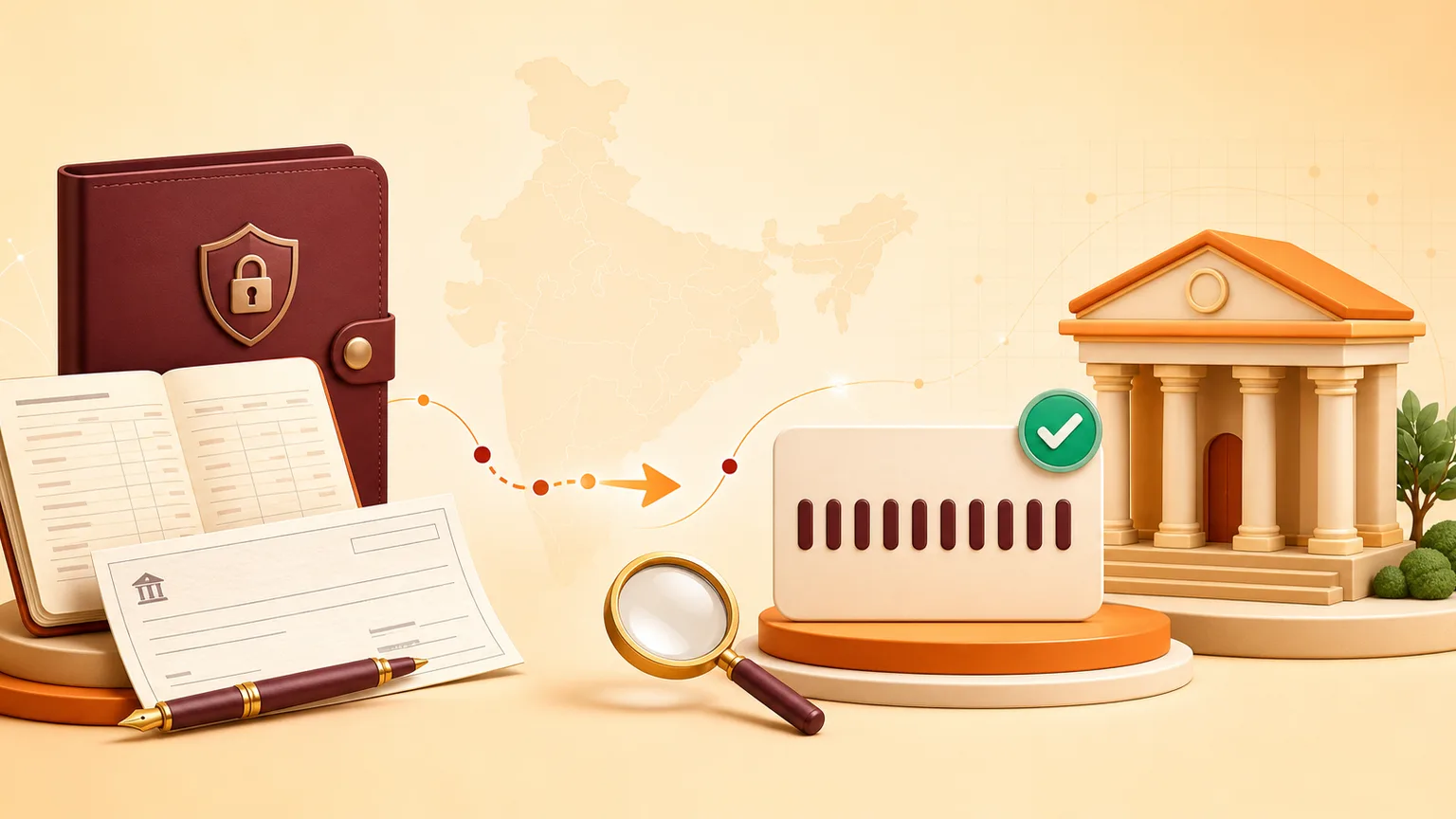
People often search for an IFSC code by account number when they need to add a beneficiary or complete a bank transfer. The important answer is simple: you cannot reliably calculate or discover an IFSC from an account number alone.
An account number identifies an account within a bank. An IFSC identifies the bank branch that participates in Indian electronic payment systems. Because banks use different account-number formats—and an account may move between branches without receiving a new number—there is no universal public formula that converts one into the other.
What is an IFSC code?
IFSC stands for Indian Financial System Code. It is an 11-character alphanumeric identifier assigned to a bank branch used by payment systems such as NEFT, RTGS and IMPS.
A typical code follows this structure:
- First four characters: the bank identifier
- Fifth character: currently reserved as zero
- Last six characters: the branch identifier
The branch identifier is not normally encoded inside the customer’s account number. That is why a trustworthy IFSC finder asks for a bank and branch—or accepts a complete IFSC for verification—instead of requesting sensitive account credentials.
Why an account number alone cannot reveal the IFSC
India does not use one universal customer account-number format across every bank. Each institution defines its own length, validation and internal structure. Even within one bank, formats may differ because of older systems, mergers or account products.
There is another practical problem: a customer may transfer an account to a different branch. The account number can remain unchanged while the applicable branch IFSC changes. A number-to-IFSC database would therefore need private, continuously updated customer-account records. Those records are not part of a public IFSC directory and should not be exposed by a third-party search website.
Seven safe ways to find the IFSC linked to your account
1. Check a recent bank statement
PDF and printed statements commonly display the servicing branch, account number and IFSC near the account-holder details. Prefer a recent statement because branch information may change following relocation, merger or account transfer.
2. Look in the passbook
The first page of a passbook generally contains the account and home-branch information, including the IFSC. If the account was transferred, ask the bank to update or reissue the passbook details.
3. Check a cheque leaf or chequebook
Many banks print the branch IFSC on cheque leaves, usually near the bank and branch address. Do not confuse the IFSC with the MICR line printed along the bottom of a cheque.
4. Use the bank’s official app or internet banking
After signing in through the official app or website, open account details, profile, statement or branch information. Avoid signing in through links received in unsolicited messages. A bank will never need your OTP or PIN merely to tell you its branch IFSC.
5. Ask the account holder or beneficiary
If you are transferring money to someone else, request the bank name, branch and IFSC directly from the beneficiary. Ask them to copy the details from a recent statement or official banking channel rather than relying on memory.
6. Contact the bank branch
Use a telephone number from the bank’s official website, your card or your account documents. Provide only the information required for branch identification. Do not disclose a password, PIN, CVV or OTP.
7. Search using the bank and branch
When you know the bank, state, city and branch, use an IFSC directory. Esperto’s IFSC code finder lets you select those four details and returns the corresponding IFSC plus available MICR, address and payment-network information.
What if you only have the beneficiary’s account number?
Ask the beneficiary for the IFSC or branch details. Do not guess a branch from the beginning or ending digits of the account number. Do not send a transfer using a code taken from an old invoice without confirmation.
Some banking apps can identify a beneficiary account through internal verification flows, but this happens inside the bank’s controlled system. It does not mean a public website can safely reverse-search every account number.
IFSC code versus account number versus MICR
| Detail | What it identifies | Typical use |
|---|---|---|
| Account number | A customer account within a bank | Crediting or referencing that account |
| IFSC | A participating Indian bank branch | NEFT, RTGS and IMPS routing |
| MICR | A bank branch in cheque processing | Machine processing and clearing of cheques |
These identifiers are related to a banking transaction, but they are not interchangeable. A MICR is typically nine digits, while an IFSC contains 11 letters and numbers.
How to verify an IFSC before transferring money
- Compare the IFSC with a recent statement, passbook, cheque or official bank channel.
- Confirm that the bank and branch shown by the IFSC search match the beneficiary’s details.
- Review the beneficiary name displayed during your bank’s payee-verification process, when available.
- For a large or important payment, send a small test amount first and obtain confirmation.
- Recheck saved beneficiaries after a bank merger, branch transfer or long period of inactivity.
An IFSC can be structurally valid yet belong to the wrong branch. Verification is therefore about matching the code, bank, branch and beneficiary—not only checking that the code has 11 characters.
Account-number and IFSC search safety
A branch-based IFSC lookup does not require your full account number. Treat these requests as warning signs on an unknown site:
- internet or mobile banking password;
- ATM PIN, UPI PIN or card CVV;
- one-time password received by SMS or email;
- remote-access or screen-sharing installation;
- an advance fee to reveal public branch information; or
- unnecessary identity documents.
IFSC information is branch-level information, not proof that a named person owns an account. A public IFSC result should never be treated as account-holder verification.
Can you convert an account number to an IFSC code?
No universal account number to IFSC code conversion exists. Banks control their own account-number structures, and those structures do not consistently expose the servicing branch. An account can also move to another branch while retaining the same account number.
That means an account number IFSC code search must use another trusted source: a bank document, the bank’s official service, confirmation from the account holder, or known bank and branch details. A third-party website should not claim it can identify any customer’s branch from a private account number alone.
Account Number Se IFSC Code Kaise Search Karein?
Account number se directly IFSC code search nahi kiya ja sakta. IFSC find karne ke liye passbook, cheque leaf, latest bank statement, official mobile banking app, internet banking, ya bank aur branch details ka use karein.
Agar bank aur branch ka naam pata hai, hamara IFSC code search tool open karein. Bank, state, city aur branch select karne par matching IFSC aur available branch details mil jayengi. Is process mein account number, OTP, PIN ya password enter karne ki zaroorat nahi hai.
Account number to IFSC code: choose the correct method
| Information you have | Correct way to find or verify the IFSC |
|---|---|
| Only an account number | Ask the account holder or contact the bank through an official channel. |
| Bank and branch known | Use the bank and branch IFSC finder. |
| Complete IFSC known | Use the IFSC branch verification tool. |
| Passbook or statement available | Check the account or home-branch details section. |
| Cheque available | Check the IFSC printed near the bank and branch information. |
| Official banking access available | Open account details inside the bank’s official app or internet banking. |
Common account number IFSC search questions
Can an account number identify the bank branch?
Not reliably through a public universal method. A bank may interpret its own account number internally, but that does not create a safe public account-number-to-branch lookup.
Is account number to IFSC code conversion possible?
No universal conversion is possible. Use a trusted document, the bank’s official channel, or the bank and branch information instead.
Can I find an IFSC code without a passbook?
Yes. Check a statement or cheque, use official mobile or internet banking, contact the bank or search using the known bank and branch.
Is it safe to enter an account number in an IFSC search tool?
A branch-based IFSC finder does not require it. Avoid unknown websites asking for a full account number, OTP, PIN, password or card information.
Frequently asked questions
Can I find an IFSC code using only an account number?
No. Banks do not use one universal account-number format that publicly encodes an IFSC. You need a trusted account document, an official bank channel, or the bank and branch details.
Where is the IFSC code printed?
It is commonly shown on cheque leaves, passbooks and account statements. It is also normally available inside the bank’s official mobile or internet banking service.
Does an IFSC change when an account moves to another branch?
It can. If the servicing branch changes, the applicable IFSC may change even when the account number remains the same. Confirm the current details with the bank.
Is it safe to enter an account number into an IFSC finder?
A legitimate branch-based finder does not need it. Avoid unknown sites that request account numbers or banking credentials for a public branch lookup.
Can I search a branch if I already know the IFSC?
Yes. Use Esperto’s bank branch lookup by IFSC to check the bank, branch, address and available payment-network details associated with a known code.
Use the right lookup for the information you have
If you know the bank and location, find the IFSC code by bank and branch. If you already have an IFSC, verify the bank branch by IFSC. If you only have an account number, use a trusted bank document or contact the account holder or bank.
This article provides general information, not banking or financial advice. Bank branches and routing details can change. Confirm current beneficiary and IFSC details through the relevant bank before initiating a transaction.