
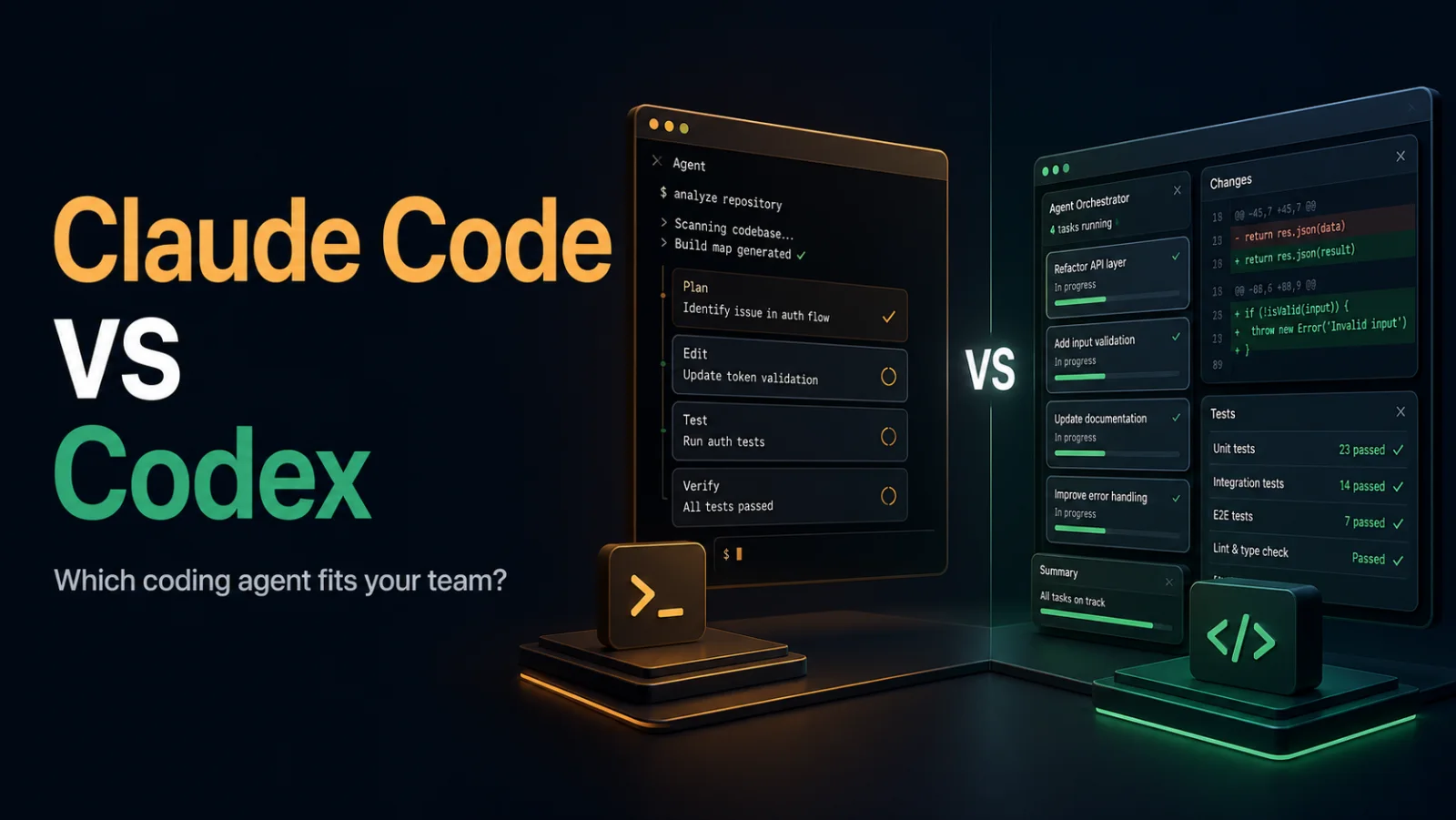
Claude Code vs Codex compares two agentic coding products that can inspect repositories, edit files, run commands and complete multi-step software tasks. Claude Code began with a terminal-centred experience and extends into IDE and automation workflows. OpenAI Codex works across CLI, IDE, web, cloud and desktop experiences, with a strong emphasis on parallel agents and delegated work.
Claude Code vs Codex at a glance
| Area | Claude Code | Codex |
|---|---|---|
| Primary workflow | Terminal-first agent with IDE and automation integrations | CLI, IDE, web, cloud and desktop agent workflows |
| Delegation | Long-running local tasks and configurable subagent patterns | Local tasks plus parallel cloud agents and automations |
| Authentication | Claude plans, Anthropic Console, Bedrock or Vertex AI | ChatGPT plans or supported API-key workflows |
| Customisation | Project instructions, hooks, tools and agent configuration | AGENTS.md, skills, plugins, rules and automations |
| Best fit | Terminal-heavy developers and Anthropic-aligned teams | Teams coordinating agents across local and cloud work |
Reviewed 7 August 2026. Both products change rapidly. Verify the official Claude Code documentation, Codex documentation and current plan limits.
What is Claude Code?
Claude Code is Anthropic’s agentic coding tool. It runs in a developer’s environment, understands a repository, edits files, executes commands and works through tasks conversationally. Anthropic supports authentication through the Anthropic Console, eligible Claude subscriptions, Amazon Bedrock and Google Vertex AI.
Its terminal-first design appeals to developers who already organise work around shells, Git, test commands and repository tools. Project instructions, hooks and specialised agent patterns can adapt behaviour to a team’s workflow.
What is Codex?
Codex is OpenAI’s coding agent for writing, reviewing and shipping code. It is available across CLI, IDE extensions, cloud, web and the Codex desktop app. OpenAI positions the desktop app as a command centre for supervising multiple agents and long-running work in parallel.
Codex combines interactive local work with asynchronous delegation. Cloud tasks run in isolated environments connected to a repository, while local tasks operate under configurable sandbox and approval controls. Skills and automations let teams package repeatable workflows beyond a single prompt.
Terminal and interactive coding
Claude Code’s interface feels natural when the terminal is the developer’s primary workspace. A developer can inspect a plan, answer questions, review edits and run project commands without adopting a separate visual environment.
Codex CLI provides a comparable terminal workflow, while the IDE and desktop surfaces allow the same product family to support other styles. If every engineer prefers the shell, Claude Code’s focus may be an advantage. If a team needs several interfaces and handoff between local and cloud work, Codex may fit better.
Parallel and asynchronous work
OpenAI’s Codex app is explicitly designed to manage multiple agents at once. This is useful when tasks can be separated into independent branches: updating documentation, investigating a bug, adding tests and implementing a feature.
Claude Code can also handle substantial tasks and supports custom agent patterns, but the product decision should focus on how naturally the team can supervise concurrency, resolve overlapping changes and understand what each agent did.
Good tasks to delegate
- add tests around an existing, well-understood behaviour;
- trace and explain an unfamiliar subsystem;
- upgrade a dependency with a clear test suite;
- prepare a contained refactor in a separate branch; or
- review a pull request for specific bug classes.
Repository instructions and reusable workflows
Both tools perform better when a repository documents commands, architecture and constraints. Claude Code can use project guidance and tool configuration. Codex reads repository instructions such as AGENTS.md and can use skills or plugins for specialised workflows.
Write instructions that are testable: where code lives, commands to run, boundaries not to cross and the definition of done. Avoid long documents full of preferences that contradict the codebase.
Models and quality
Claude Code uses Anthropic’s Claude models through the selected account or enterprise platform. Codex uses OpenAI’s coding-optimised model family, with model availability determined by the current product and plan.
Benchmarks are not enough. Test both products on your language, framework, repository size and test suite. Score:
- correct files selected;
- instruction following;
- tests written and passed;
- security mistakes;
- unnecessary diff size;
- review time; and
- accepted changes after human review.
Security and permissions
Agentic tools can read code, modify files and invoke commands. That creates more capability—and more risk—than ordinary autocomplete. Apply least privilege, protect credentials, review network access and treat external text as a possible prompt-injection source.
OpenAI documents native configurable sandboxing in Codex, with agents restricted by default and permission required for elevated operations such as network access. Claude Code teams should similarly configure permissions and hooks appropriate to their environment and deployment platform.
Neither tool should deploy an important change without human review, automated tests and normal release controls.
Pricing
Claude Code can be accessed through eligible Claude subscriptions, Anthropic API billing or supported enterprise cloud platforms. Codex is included across ChatGPT plans with limits that vary, and additional usage may consume credits. OpenAI’s current rate card uses token-based credit consumption for most plans.
Model selection, repository context, task duration and concurrency affect cost. Measure cost per accepted task, not price per prompt. A long agent run that passes tests and saves an hour can be economical; a cheap run that creates a plausible but incorrect migration can be expensive.
Who should choose Claude Code?
- Developers who want a focused terminal-native coding agent.
- Teams already standardised on Claude or Anthropic’s enterprise options.
- Workflows built around shell tools, hooks and explicit local supervision.
- Projects where Claude’s behaviour performs best in internal evaluations.
Who should choose Codex?
- Teams wanting CLI, IDE, desktop and cloud workflows in one product family.
- Developers supervising multiple parallel agents.
- Organisations using repeatable skills, automations and code review.
- Teams already using ChatGPT plans and OpenAI models.
Final verdict
Claude Code and Codex are both serious agentic development tools. Claude Code is especially coherent for terminal-centred work. Codex has a broader orchestration story across local, cloud and desktop surfaces. Choose through a controlled pilot, preserve human accountability and require evidence—diffs, logs and passing tests—for every agent-produced change.
If you prefer an editor-first product, compare Cursor vs Windsurf.